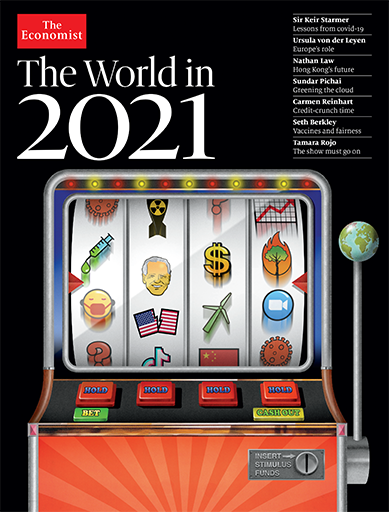
The Economist launched The World in 2021, its annual look at the important themes and trends that will shape the year ahead. The Economist predicts that 2021 will be a particularly unpredictable year given the interactions between the still flourishing covid-19 pandemic, an uneven economic recovery and fractious geopolitics.
Following last year's edition, Tom Standage, deputy editor of The Economist, was named the new editor of The World in and its larger franchise, The World Ahead. Under Mr Standage's leadership, a special section was added to this year's edition called Aftershocks, which will consider the lessons and opportunities of a post-crisis world.
Reflecting on this year's The World in 2021, Tom Standage said: "The number 21 is connected with luck, risk, taking chances and rolling the dice. That seems appropriate for what promises to be a year of unusual uncertainty." Mr Standage continued: "The great prize on offer in 2021, of course, is the chance to bring the coronavirus pandemic under control. But in the meantime risks abound, to health, economic vitality and social stability."
Now in its 35th year, The World in 2021 will be available within The Economist app, online today and on newsstands on December 1st (UK) / December 4th (US). The annual edition can also be purchased at The Economist Store at Global Book Corporation
The top ten themes cited for 2021 are:
The World in... sits alongside the annual summertime supplement, The World If... as the twin pillars of The Economist's future-gazing franchise, The World Ahead. They are augmented by a monthly podcast of the same name, The World Ahead, which considers what-if conjectures and provocative prophecies. It's available on Apple Podcasts, Spotify, Google, Stitcher and TuneIn.
The Economist's journalists are joined in The World in 2021 by leaders from business, politics, science and the arts, who add their ideas for the coming year: Keir Starmer, leader of the Labour Party; Michael Tubbs, mayor of Stockton, California; Ursula von der Leyen, president of the European Commission; Kishore Mahbubani, distinguished fellow, Asia Research Institute; Nathan Law, pro-democracy activist from Hong Kong; Alan Doss, outgoing president, Kofi Annan Foundation; Mo Ibrahim, chairman, Mo Ibrahim Foundation; Claudia López, mayor of Bogotá; António Guterres, secretary general, United Nations; Anne Hidalgo, mayor of Paris; Lynn Jurich, CEO, Sunrun; Erica Brescia, chief operating officer, Github; Azeem Azhar, CEO, Exponential View; Ursula Bassler, president, the CERN council; Toby Ord, Future of Humanity Institute; Michele Wucker, strategist and author; Sundar Pichai, CEO, Google; Tamara Rojo, artistic director, English National Ballet; Carmen Reinhart, chief economist, the World Bank; Seth Berkley, CEO, GAVI; Sarah al-Amiri, UAE science minister and Hope science lead.
This mix of contributors makes The World in 2021 uniquely authoritative in its analysis and prediction of trends and events—and has won the franchise a loyal and growing following around the world.
About The Economist
With a growing global audience and a reputation for insightful analysis and perspective on every aspect of world events, The Economist is one of the most widely recognised and well-read content in the world. In addition to the content being fully available on the website, the flagship print edition is published weekly, and The Economist also produces Espresso, a daily news app, Global Business Review, a bilingual English-Chinese product and Economist VR, a virtual-reality app. Economist Radio produces several podcasts a week and Economist Films produces short- and long-form video. The Economist maintains robust social communities on Facebook, Twitter, LinkedIn, Instagram, Medium and other social networks. A recipient of many editorial and marketing awards, The Economist was named the most trusted news source by the 2017 Trusting News Project Report.